
Do employees disengage during your corporate training programs? Do they abandon courses midway or treat training as a compliance requirement rather than a learning opportunity? If so, it may be time to rethink traditional training approaches.
By incorporating immersive learning into corporate training, L&D teams can transform routine online courses into engaging, hands-on experiences. These digital environments replicate real-life work situations, allowing employees to practice skills, make decisions, and learn from mistakes before facing real-world business challenges.
As learners understand the context in which they will be using the skills, they begin to appreciate the value of the training. This learning methodology helps learners greatly:
- Engaging with the course
- Improving their skills faster
- Becoming job-ready
- Increasing their confidence
This blog explores what immersive learning is, the benefits it offers both organizations and learners, and the instructional design strategies that make it effective.
Table Of Content
What is Immersive Learning?
Immersive learning is a training approach that places learners in interactive environments designed to reflect real-world work situations. Instead of passively consuming content, learners actively participate, face challenges, make decisions, and build skills through realistic practice.
In corporate L&D, immersive learning helps make training more engaging, practical, and learner-centered. As training methods evolve with technology, organizations are moving beyond traditional content delivery and adopting strategies that encourage active involvement and better knowledge retention. By creating experiences that closely mirror workplace scenarios, immersive learning prepares employees to apply what they learn more confidently on the job.
Immersive Learning Strategies for Effective Corporate Training
Explore key instructional design strategies to craft immersive learning programs:
- Scenario-based Learning
- Simulations
- Gamification
- Storytelling
What are the Benefits of Immersive Learning for Corporate Training?
Here are some of the key ways immersive learning helps employees learn more effectively:
1. Stronger Learner Engagement and Better Retention
In large enterprises, training effectiveness depends on more than just content availability. When employees across regions and business units are expected to complete training amid competing priorities, disengagement becomes a serious challenge for L&D teams. Immersive learning helps address this by making training more active, relevant, and experience-driven. Instead of passively consuming information, learners interact with realistic situations, make decisions, and remain mentally involved throughout the learning process. This deeper involvement often leads to better understanding and stronger retention.
Watch this video to get tips on how to boost learner engagement in corporate training.
2. Faster Skill Application and Improved Job Performance
For organizations managing recurring learning initiatives such as compliance training, system adoption, process change, and sales enablement, training must translate into measurable performance outcomes. Immersive learning supports this by placing learners in job-relevant contexts where they practice applying knowledge instead of simply reviewing information. As a result, employees can move from training to real-world execution more quickly, reducing time to proficiency and improving workplace performance.
3. Safe, Practical Learning for High-Stakes Work
In many enterprise roles, employees must make decisions that directly impact compliance, customer experience, operational efficiency, or safety. This is especially true in high-stakes industries such as healthcare, manufacturing, financial services, aviation, energy, and pharmaceuticals, where mistakes can lead to serious operational, regulatory, or safety consequences. Immersive learning creates a safe environment where learners can practice these decisions without real-world consequences. By simulating workplace situations and allowing learners to experiment, make mistakes, and learn from them, organizations can better prepare employees for complex responsibilities.
4. More Effective Training for Distributed and Remote Teams
For decentralized organizations operating across multiple regions and time zones, delivering consistent and engaging training can be challenging. Immersive learning helps bridge this gap by making digital training more participatory and realistic. It reduces the sense of distance often associated with standard online courses and creates a more engaging learning experience for employees regardless of location.
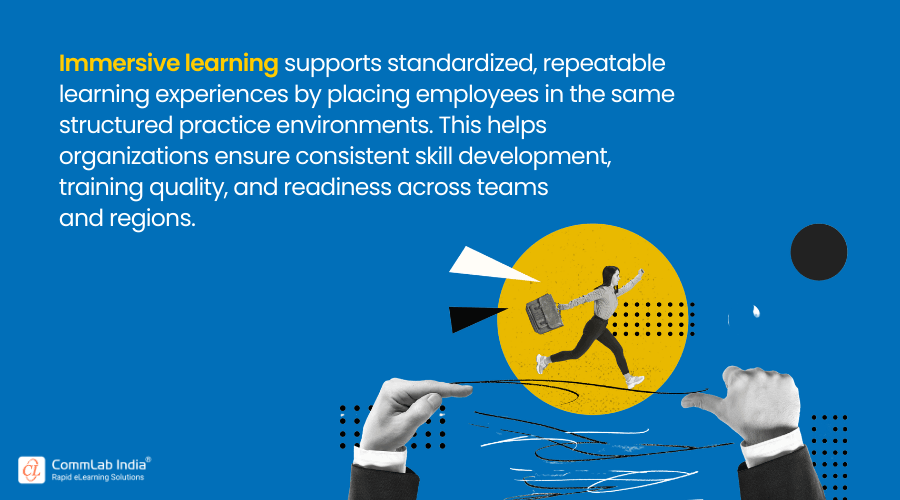
5. Greater Consistency Across Enterprise Learning Operations
As training demand grows across departments, launches, and recurring learning cycles, maintaining consistency becomes a major operational challenge.
Why Immersive Learning Helps Employees Learn Better
1. Hands-On Skills Training
Simulation-based learning gives employees the opportunity to develop practical skills through direct experience. Instead of simply reading or watching training material, learners participate in scenarios that reflect the situations they may encounter at work. This learn-by-doing approach allows them to apply knowledge while performing tasks, helping them gain confidence and practical understanding.
For example, employees learning a new software application can explore the system, identify common issues, and practice solving them in a simulated environment. Programming labs and practice modules allow learners to test their skills and improve through guided practice.
2. Fewer Distractions and Greater Knowledge Absorption
Effective learning requires focus. Immersive learning environments are designed to capture the learner’s attention and keep them engaged with the training experience. By presenting information through interactive scenarios and structured tasks, learners can concentrate more fully on the material and absorb concepts more effectively.
When learners are actively engaged in the learning process, they are less likely to be distracted and more likely to retain what they learn.
3. Repeated Practice That Leads to Mastery
One of the most powerful aspects of immersive learning is the opportunity for repetition. Learners can practice tasks multiple times, learn from mistakes, and refine their skills through feedback. This repeated exposure strengthens understanding and helps learners gain mastery over complex processes.
For example, workers in manufacturing environments can practice safety procedures or operational tasks through simulation-based training. Repeating these activities in a safe environment prepares them to handle real-world situations more confidently and effectively.
What are the Instructional Design Strategies for Immersive Learning?
Instructional design strategies for immersive learning are the methods used to create training experiences that are interactive, realistic, and engaging. Some of the most effective strategies include scenario-based learning, simulations, gamification, storytelling, video-based learning, and interactive training videos. Each of these approaches helps employees learn more actively and apply knowledge more effectively on the job.
1. Simulations
Simulations are one of the most effective forms of immersive learning because they allow employees to practice tasks in a realistic, risk-free environment. By recreating workplace situations, simulations help learners build practical skills and improve job performance without the pressure of real-world consequences.
Learners tend to retain knowledge better when they interact directly with tools, systems, or processes rather than simply reading or watching training material. Simulation-based training makes this possible by allowing employees to work on the actual software, equipment, or workflow they will use on the job.
Simulation-based training often follows a watch–try–do model, where learners first observe a task, then practice it, and finally perform it independently. This learn-by-doing approach is particularly valuable for high-risk or complex roles, such as:
- healthcare professionals practicing medical procedures
- manufacturing workers learning safety protocols
- employees adapting to new enterprise software systems
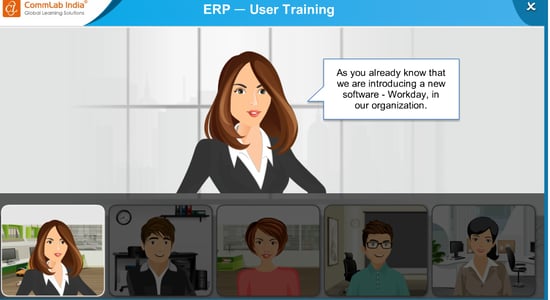
Example: To make software training more practical and effective, we designed Workday simulations that gave end-users hands-on exposure to how the HRIS application actually works.
2. Scenario-Based Learning
With scenario-based learning, employees learn through realistic situations instead of passive content. For L&D teams, this solves a common problem: training may explain concepts well, but employees often struggle to apply them in real work situations. Scenario-based learning closes that gap by placing learners in context-rich situations where they must think, decide, and respond as they would on the job. This makes training more engaging, more relevant, and far more useful for building decision-making, critical thinking, and problem-solving skills.

It is especially valuable when organizations need training to go beyond awareness and actually influence workplace behavior. Scenario-based learning helps L&D teams:
- make training feel more relevant to day-to-day work
- improve learner engagement by replacing passive content with active choices
- prepare employees for real decisions, not just knowledge checks
- build confidence in handling complex or high-pressure situations
- improve retention by connecting learning to realistic workplace context
Example: In financial services compliance training, scenario-based learning can place relationship managers in a realistic customer interaction where they must identify red flags, respond appropriately, and make compliant decisions. Instead of simply reading policies, employees practice applying them in context, which makes the training more meaningful and easier to transfer to the job.
3. Storytelling
Storytelling is a powerful immersive learning strategy because it helps employees connect with training at a human level. One of the biggest pain points for L&D teams is that employees often see training as information to complete, not something to relate to or remember. Storytelling helps solve this by giving learning a narrative structure, emotional context, and real-world relevance. Instead of presenting content as isolated facts, it places ideas in situations learners can recognize, follow, and make sense of more easily.
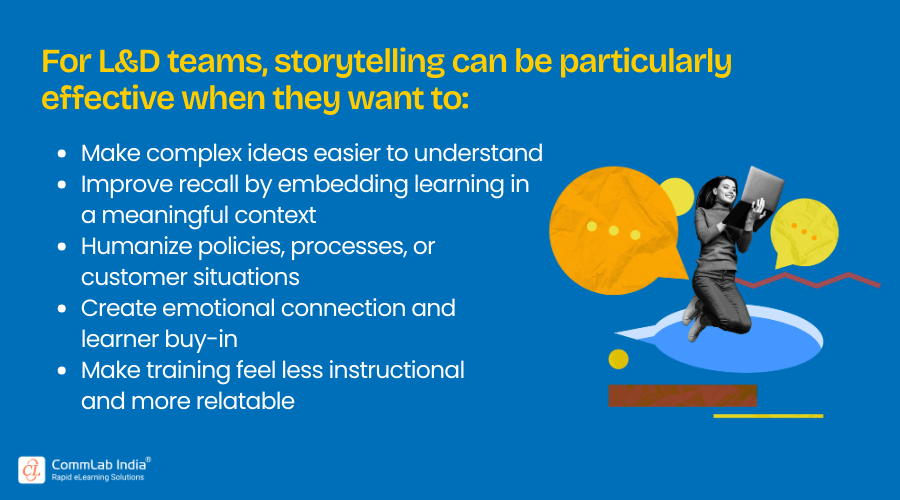
This is especially useful when training involves behavior change, judgment, or concepts that may otherwise feel too abstract or disconnected from day-to-day work. Storytelling makes learning more memorable by helping employees see not just what to do, but why it matters and how it plays out in practice.
Stories help learners by:
- Demonstrating how they should act in a particular situation
- Making it easier to understand abstract concepts through anecdotes and analogies
- Offering visual metaphors, a powerful tool to help people learn
Example: In compliance training for healthcare and pharmaceuticals, storytelling can follow a medical professional handling a patient case or a field representative communicating drug information while adhering to regulatory guidelines.
4. Gamification
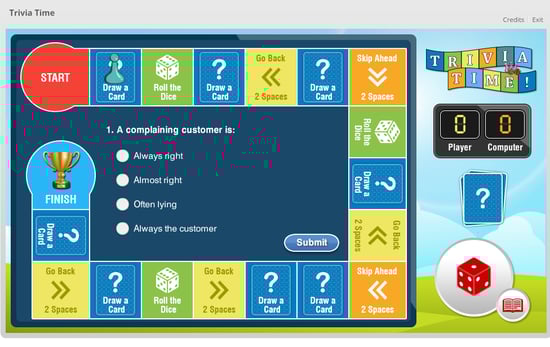
The use of game elements and game mechanics in non-game contexts makes training more engaging, motivating, and memorable. It helps L&D teams solve a familiar challenge: how to keep learners interested when the subject is mandatory, repetitive, or perceived as dry. This is especially relevant for areas such as compliance training, where static slides and policy-heavy content often fail to hold attention. By adding challenge, progress, and reward, gamification makes learning feel more active and sticky. It can also create a more immersive experience by placing learners in realistic contexts where they solve problems, make decisions, and see the outcomes of their choices.
For L&D teams, gamification can help:
- increase learner motivation and participation
- make mandatory training feel less monotonous
- improve attention and completion rates
- reinforce learning through challenges, activities, and assessments
- encourage progress through elements such as scores, levels, badges, and leaderboards
- make complex work situations easier to explore in an engaging format
Example: A course to teach employees customer relations is made engaging when employees play a game where they learn to identify customer problems.
Immersive Strategy: A Bonus Mention
Video-based learning
Training videos make content easier to understand, more engaging, and more relevant to the job. It helps L&D teams solve a common challenge: explaining concepts clearly while keeping learners interested. Depending on the need, organizations can use explainer videos, talking-head videos, scenario-based videos, screencast videos, 360-degree videos, and animated videos.
Interactive training videos make the experience even more engaging by turning passive viewing into active participation. Instead of only watching, learners respond to prompts, make decisions, and receive feedback within the video itself.
For L&D teams, video-based learning and interactive training videos can help:
- simplify complex topics through visual explanation
- show employees how to perform tasks or handle situations
- make training more engaging and less passive
- improve retention through active participation
- support scalable learning across distributed teams
Example: In manufacturing safety training, 360-degree videos can immerse workers in a realistic shop-floor environment where they can look around, identify hazards, and observe correct safety procedures from every angle. For instance, employees can virtually step into a production line, spot potential risks such as improper equipment handling or safety violations, and learn the correct response.
Frequently Asked Questions (FAQ) About Immersive Learning in Corporate Training
If you’re considering immersive learning for your organization, these answers will clarify how it works and where it delivers the most value.
1. How does immersive learning improve employee performance?
A. By allowing employees to practice in realistic contexts, immersive learning shortens the gap between training and real-world application. Employees gain confidence, improve decision-making, and perform tasks more effectively on the job.
2. Can immersive learning be used for compliance training?
A. Yes, immersive learning is highly effective for compliance training. It allows employees to experience real-life compliance scenarios, understand consequences of decisions, and practice correct actions—making compliance training more engaging and memorable.
3. How does immersive learning support sales training?
A. In sales enablement, immersive learning helps learners practice real customer interactions, handle objections, and make decisions in simulated environments. This improves confidence and prepares sales teams for actual conversations.
4. Is immersive learning suitable for product and software training?
A. Absolutely. Immersive learning is widely used for product and software training, especially during new system rollouts. It allows employees to explore features, practice workflows, and troubleshoot issues before using the system in real work scenarios.
5. How does immersive learning help in technical training?
A. For technical training, immersive learning provides hands-on practice through simulations and guided exercises. Employees can learn complex processes, test their understanding, and refine their skills without the risk of real-world errors.
6. Which industries benefit the most from immersive learning?
A. High-risk and complex industries such as healthcare, manufacturing, financial services, pharmaceuticals, aviation, and energy benefit greatly from immersive learning because it improves safety, compliance, and job readiness through realistic practice.
7. Is immersive learning effective for remote and distributed teams?
A. Yes, immersive learning helps create more engaging and consistent training experiences for remote employees. It makes online learning more interactive and reduces disengagement, even in distributed work environments.
Immersive Learning — The Future of Corporate Training
Immersive learning is unarguably the future of corporate training. With technology continuing to reshape workplace learning, organizations are moving beyond static courses and embracing training experiences that are more interactive, contextual, and effective. At the same time, AI-powered instructional design is becoming a powerful enabler of immersive learning—helping L&D teams design richer scenarios, faster simulations, smarter interactions, and more personalized learning journeys at scale.
The real question is no longer whether immersive learning matters, but how quickly organizations can build it well. If you want to explore how AI is transforming instructional design and helping create more impactful learning experiences, download our eBook on AI in Instructional Design and discover what it takes to design the next generation of corporate training.
Editor’s note: This post was originally published on July 29, 2016 and has been updated for comprehensiveness.

View the original article and our Inspiration here