
Think back to your own childhood as a student in school. Do you recall going on any field trips? Maybe you toured an art museum and can still picture your favorite work. Perhaps you went to a zoo or aquarium and learned about an animal you never knew existed. Maybe you watched a play or a musical performance that sparked a lasting interest in the arts. Field trips give students the chance to experience things they might not otherwise encounter in their daily lives, and they can have a lasting impact on a child’s education.
In this article
If you are searching for school field trip ideas, this article offers a range of destinations you can consider across subjects and ideas for turning them into a trip that reinforces what your students are learning. A field trip serves as a link between school and the outside world, and it can support what students are learning in the classroom when it is planned with a clear purpose.
Benefits of Field Trips
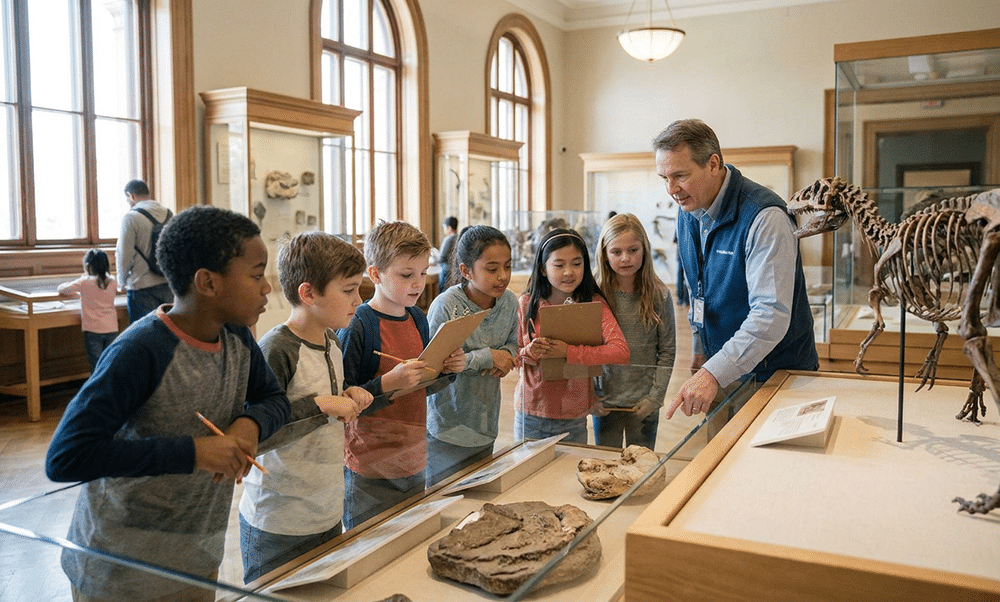
Field trips can be a fun excursion for your students and for you, allowing you all to explore the outside world during class time. It’s quite possibly the highlight of many of your students’ year! But there are so many more benefits to field trips aside from a fun outing. Research points to students who participate in culturally enriching field trips, like museums, theater, or a symphony, correlating with higher course grades and reduced behavioral referrals (University of Arkansas research summary (opens in a new tab)). Other studies cite the social and emotional benefits of field trips, identifying how student well-being improves, resulting in increased student motivation inside the classroom. Importantly, too, the additional field trip time spent outside of the classroom does not show any decreases in academic performance (Teach Maverick (opens in a new tab)). And decades of research have pointed to the idea that when field trips are connected to classroom instruction rather than treated as a stand-alone event, these types of experiences show the strongest student benefits in terms of academic improvement, reduction in behavior issues, and overall improvement in a student’s well-being (Edutopia (opens in a new tab)). This is why the ideas for field trips that we will share below will also be paired with thoughtful consideration of a planning process. A fun field trip outing can turn into a strong learning experience when you ensure that your curriculum is well-aligned to the student activities for their next field trip!
The Many Purposes of a Field Trip
Before choosing a destination, it helps you to know why you are taking that particular trip. Field trips are planned for many reasons.
-
1 Purpose
An introduction to a new unit
First, they can serve as an introduction to a new unit. A field trip can be an excellent way to build your students’ interest in a topic you are about to study in depth. If your fourth-grade students are about to learn about the role of state government, a trip to the state capital could be a strong opening to the unit.
-
2 Purpose
A culminating event at the end of a unit
Second, a field trip can serve as a culminating event at the end of a unit, where students apply the knowledge they learned in class. An example might be taking your first-grade students to a strawberry farm after learning about the life cycle of plants.
-
3 Purpose
An opportunity for research or information gathering
Third, a field trip can be an opportunity for research or information gathering. This purpose can support a project-based learning cycle you are running in your classroom. Imagine that your high school students are building a charitable organization to serve their local community. A visit to nonprofit organizations in their city to learn how those groups serve others could be a powerful experience.
The purpose of your field trip can be just as important as where you go! In fact, considering the purpose first helps you choose the exact right field trip that aligns best with your content area and instruction. The ideas in the next section are organized by subject so you can collect ideas that might benefit your classroom, based on what you are teaching now.
School Field Trip Ideas by Subject
The first step when planning any field trip is choosing where to go (Field Trip Directory (opens in a new tab)). Begin by listing your upcoming units of study and the big concepts taught within those units. Next, brainstorm local destinations that might tie in to those concepts. The ideas below are grouped by subject to help you start that list.
Science and Nature Field Trip Ideas
Science units offer some of the most direct connections to real destinations.
For plant life cycles or photosynthesis, consider a botanical garden, a working farm, a nature preserve, or a state park, where students can explore different plant species and see what makes them grow. For animal life cycles, a zoo, an aquarium, an animal rescue habitat, or a nature preserve lets students learn about each animal’s natural habitat. For the water cycle, rocks and minerals, a science museum or a local cave gives students a chance to see the concepts in person. For conservation, a recycling center or a water treatment facility lets students hear about conservation efforts in their own community. For the principles of flight, an air and flight museum or a small private airport lets students view the structure of planes and the mechanics of flight.
History and Social Studies Field Trip Ideas
For a specific period in history, a history museum or a well-known historical site lets students see the actual artifacts they read about in their textbooks. A local historical society, a state capitol, a courthouse, or a preserved landmark can serve the same purpose closer to home. For community helpers, a police station, a fire station, or a post office lets younger students see that work in action.
Art, Music, and Performance Field Trip Ideas
For art history or a particular genre of art, an art museum or a sculpture garden lets students see the concepts studied in class. For music and the performing arts, a theater or a musical production gives students a live experience many of them have never had. As one example from the research above, a visit to an art museum has been linked to gains in critical thinking and empathy, as well as improved well-being!
Economics and Community Field Trip Ideas
For economics, a store, a bank, a factory, or a restaurant lets students view microeconomics principles in action. For math calculations, a local farm can show students how farmers calculate crop production. For essay writing, a news station can show students how details in a story matter for clarity. These everyday destinations are often free or low cost, and many local businesses welcome a class when the visit helps students understand what they do.
Seasonal Field Trip Ideas
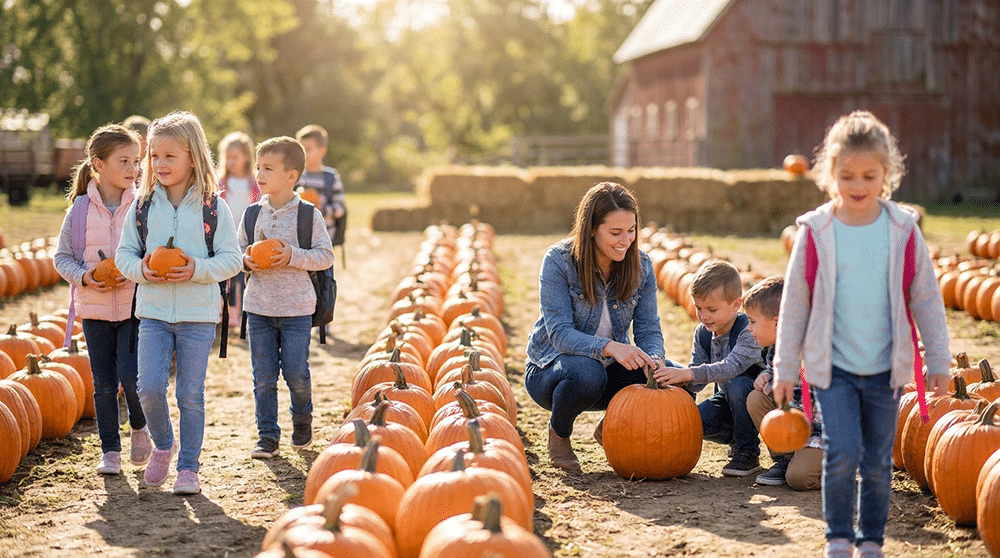
Some of the most popular field trips can also follow the seasons. In the fall, an apple orchard or a pumpkin patch can relate well with your lessons on plant life cycles, harvests, and local agriculture, and many offer hay rides or corn mazes that make the visit exciting for your students. A farmers market gives students a look at seasonal produce and a chance to learn where their food comes from and how local farms operate. A local farm can also work in any season for lessons on animals, crops, and the origins of food. These trips also connect naturally to many subjects, like science and social studies units, and give students a hands-on look at their local community.
More and more field trip destinations are developing virtual options. These often involve live webcams, prerecorded video lessons, and other digital presentations of a place. The advantages of virtual field trips include reduced cost and the ability to visit places that are far away geographically. Institutions such as the Smithsonian (opens in a new tab) and the National Park Service (opens in a new tab) offer virtual tours and online lessons you can bring into your classroom.
A virtual field trip could be a good option when a physical trip is not possible, though it is best when you pair it with hands-on application in your classroom. For example, if you plan a virtual field trip that explores a working farm, you might arrange for a company to bring farm animals to a small event on your school campus to extend the experience and help ensure your students can see the connection to real life.
How to Turn a Destination Into an Instructionally-Aligned Field Trip
Choosing a destination is only one component of the field trip planning process. What makes a great field trip that is valuable in your classroom is combining that destination with strong logistics planning, the process for building the field trip experience aligned with your classroom lessons, and designing follow-up activities after the field trip takes place (Instructionally-Aligned Field Trips).
1
Plan the Logistics
Once you have chosen a place, it is time to plan the logistics. You will most likely need approval from your administrative team, and they will want to know the details before they grant permission. Calculate the total cost of the trip, including admission, any fees for guides or materials, transportation, and food. Ask about the student-to-adult ratio the destination requires and make sure the location can accommodate your group size. Check your school and district calendar to avoid conflicts such as state testing or blackout dates. Then confirm transportation, and send home permission slips that include timing, what students need to bring, and any emergency, allergy, or medical information you should have on hand.
2
Build the Field Trip Experience Around Your Curriculum
The field trip experience itself should be purposefully planned to support student learning both before and during the trip. The best field trip experiences have three strong qualities: a clear alignment of field trip activities to your classroom curriculum, a rich learning or cultural experience that also supports students’ social and emotional development, and a hands-on component that gives students interactive activities during the trip.
Start with alignment. Consider the content standards you are responsible for teaching during the unit, and ask what students can learn on this trip that ties into that knowledge. Then write clear learning objectives.
Consider what makes a rich experience. A rich experience is one that most students would not otherwise have in their daily life. Consider the depth at which students can interact with the activities. Even a visit to a familiar place, such as a local restaurant, can become a rich experience when you build it around how a business functions, giving each student a chance to see how the manager tracks food inventory or handles orders.
Plan for hands-on engagement. The best field trips are not full of experiences where students only listen to presentations. Instead, they involve movement and the chance for students to engage with the content actively.
For example, at the elementary level, imagine taking a class of third graders to a nature preserve after learning about food chains and food webs in class. Provided the guide knows your intentions, he or she can focus the discussion on observing evidence of food webs in the preserve. Students could take digital photos of different elements in a food web and then create a digital display once back at school.
Or, at the secondary level, if your seventh-grade Texas history class has been learning about the Battle of the Alamo, then visiting the actual Alamo in San Antonio, Texas would be a strong experience. Students could work in small groups to sketch a map of the mission while they tour it, then create a slide deck or poster of their images and the facts they learned.
3
Design Follow-Up Activities
A field trip’s benefit to students is limited if there is no follow-up afterward. Extension activities are critical to reinforcing concepts and tying their field trip back into specific concepts they should be learning.
For the lesson extension, classmates should discuss their activities and what they learned as soon as they return, either as a whole class or in smaller groups. Older students might complete an essay or a presentation, write a summary, build a slide deck with photographs, or create a bulletin board of what they learned to display in a common area of the school. If students gathered data on the trip, the follow-up could involve analyzing that data and considering how it applies to their earlier learning.
Try This
Put this planning process to work before your next trip. Consider the units you plan to teach for the year and determine a unit and field trip location that would work well together. Then ask yourself these questions:
- Can I align specific field trip activities with my current classroom curriculum?
- Am I able to plan for rich experiences within my selected field trip?
- Will I provide interactive, hands-on activities for my students?
- What extension activities will I provide after the field trip that connect their field trip experience to my curriculum?
Planning for your field trips with these ideas in mind ensures that every destination is purposeful and impactful for your students!
Plan Stronger Field Trips With These Model Teaching Courses
Further reading
Frequently Asked Questions About School Field Trips
What are some good field trip ideas for elementary students?
Elementary students respond well to concrete, hands-on destinations that connect to a current unit. A nature preserve or zoo pairs with life science, a fire station or post office pairs with a community helpers unit, and a farm or pumpkin patch pairs with lessons on plants and food. Choose a place where young students can move, observe, and touch rather than only sit and listen.
How do I plan a field trip on a tight budget?
There are so many destinations that can be free or low cost, like a fire station, post office, local park, farmers market, or a nearby business that welcomes school groups. Ask whether the destination offers a reduced group rate, check whether your grade level or PTA has a field trip budget, and confirm how transportation will be covered before you commit. When a physical trip is just not possible, you can also consider a virtual field trip that lets you visit far-away places at little to no cost.
How long should a field trip be, and how often should I take one?
Field trip length depends on the destination and your students’ ages, and the planning process matters more than the frequency. Rather than aiming for a set number of trips, plan each one around a specific unit so the time out of the classroom reinforces what students are studying. A shorter, well-aligned trip is more valuable than a longer trip with no clear purpose.
How do I make sure a field trip supports learning and stays connected to my instruction?
Tie the trip to your content standards, write clear learning objectives, and share them with students ahead of time. Build in a hands-on activity during the trip and a lesson extension afterward, such as a discussion, a written reflection, or a presentation. When students know what they are looking for and have a task to complete when they return, the trip naturally aligns with your instruction and can reinforce classroom concepts.
References
- Erickson, Heidi H., Angela R. Watson, and Jay P. Greene. “An Experimental Evaluation of Culturally Enriching Field Trips.” Journal of Human Resources 59.3 (2024): 879–904.
- Mann, Jeff, Tonia Gray, et al. “Getting Out of the Classroom and Into Nature: A Systematic Review of Nature-Specific Outdoor Learning on School Children’s Learning and Development.” Frontiers in Public Health 10 (2022).
- Greene, Jay P., Brian Kisida, and Daniel H. Bowen. “The Educational Value of Field Trips.” Education Next 14.1 (2014).
- Behrendt, Marc, and Teresa Franklin. “A Review of Research on School Field Trips and Their Value in Education.” International Journal of Environmental and Science Education 9.3 (2014): 235–245.
- DeWitt, Jennifer, and Martin Storksdieck. “A Short Review of School Field Trips: Key Findings from the Past and Implications for the Future.” Visitor Studies 11.2 (2008): 181–197.
- Orion, Nir. “A Model for the Development and Implementation of Field Trips as an Integral Part of the Science Curriculum.” School Science and Mathematics 93.6 (1993): 325–331.
The Model Teaching Bundle for Teachers
If you have license renewal needs, salary advancement needs, or simply continuing education needs to improve your classroom practice, Model Teaching has courses and bundles for you.
Access our full course menu here, which includes 100+ courses like the ones suggested in this article, plus the university partnerships that award graduate credit.
Professional development for schools and districts
View the original article and our Inspiration here