
ICYMI – A school superintendent, education AI innovator, and heterodox thinker walk into a bar. Mike Goldstein, Kelly Coffin, and Bibi Groot joined me to talk AI and evidence on a LinkedIn Live from Eedi Labs and Bellwether. How do you balance the speed of AI product creation and adoption with a need to recall evidence? What’s the role of vendors, schools, and government? Is cognitive offloading inevitable or can it be mitigated, and how? Great crew to walk through those questions. Watch here.
Jed Wallace and I sat down with Pat Brantley—leader of Friendship Public Charter School in Washington, D.C., and soon-to-be inductee into the Charter School Hall of Fame—for a live WonkyFolk at one of her schools in Northeast Washington. You can watch the live recording here, or listen below or wherever you get podcasts.
Coming Attractions
I’ll be speaking June 3rd at WelcomeFest on Wednesday in D.C. along with NPU’s Keri Rodrigues and Rep. Kristen McDonald Rivet (D-MI) about why education isn’t front and center in the political conversation despite the severity of the problems post-Covid.
On June 10th, recovering psychometrician, pride of Iowa, accomplished musician, and beloved Bellwether team member Michelle Croft will join me for a conversation about AI and assessment. This is our third “Ask a Psychometrician” installment where I pepper her with questions about this and that and she humors me. A lot of AI hype, yes, but what should we really expect? Michelle’s seen assessment innovation from a few angles. She’ll get you up to speed and tell me if/why I am wrong about today’s post below.
Later in June I’ll host a Bellwether webinar for MetaMetrics about understanding reading and math achievement tied to a forthcoming paper from Bellwether.
You can catch me, Lindsay Fryer, and Roberto Rodriguez for a fireside chat at AASA’s legislative conference in July.
Want Eduwonk.com in your inbox via Substack? Sign up for free here.
Can AI Breathe Life Into PBL?
Like most people, I’ve changed my mind about a lot of things over time. Sometimes it’s because of new evidence or information. Sometimes it’s because I’ve been persuaded by a different perspective. And sometimes it’s because of changes in technology. For instance, in education, the now-widespread availability of student-level data means a lot of people think differently about accountability questions than they did in the past. I do.
A practice I’ve been skeptical about over the years is project-based learning. Not inherently but as an accountability tool. Not because projects aren’t a good way for kids to learn and demonstrate what they know and can do. And not because I’m not predisposed that way—I believe experiential education is powerful and have worked in that part of the sector in a couple of ways. Rather, my concern is just that at any scale, or as consequential accountability tools, the track record for PBL is generally poor for easily predictable reasons. In practice, it’s an equity trap as well, where poor kids get lower expectations and like a lot of people I have seen some horror stories that way.
Yes, there are always exceptions, and I, too, can point to some exceptional schools, but in general one of two things happens when student work is not up to par. The first is that it’s hard to be referee and coach, and so for anything with real consequence, educators don’t want to deny a kid they’re in community with who has worked hard but fallen short. Any stakes for the adults add to this.
Or, to address this problem, schools bring in third parties. You may have been invited in as an expert of some kind to “judge” student work in capstone projects. It all sounds real and authentic—‘we bring in real experts to talk to the kids about their work!’—until you consider that only a real sociopath is going to tell some kid they have no relationship with that their work is lousy. At best it’s coded gently; at worst it’s not good feedback or signaling for kids, but everyone has a nice morning or lunch and the kids leave with a false sense of how things stack up (or maybe worse they realize it’s a hustle and are deflated).
Enter new tech. Namely AI.
AI isn’t sociopathic; if anything, it’s sycophantic (“You’re absolutely right!” “That’s the question!” “Now we’re getting to the good stuff!”). But you can design it to adhere to and evaluate against a metric. It’s pretty good at giving feedback against a metric and feedback that isn’t burdened by understandable and empathetic human impulses. You can make it emotionless and sterile as an evaluative tool.
That’s on offer now. It’s also scalable.
I have no idea what the Venn diagram is of people who like AI and people who like PBL. But I hope they find each other. This is a technology that might just help us do some things on assessment that a lot of people like but have been skeptical of.
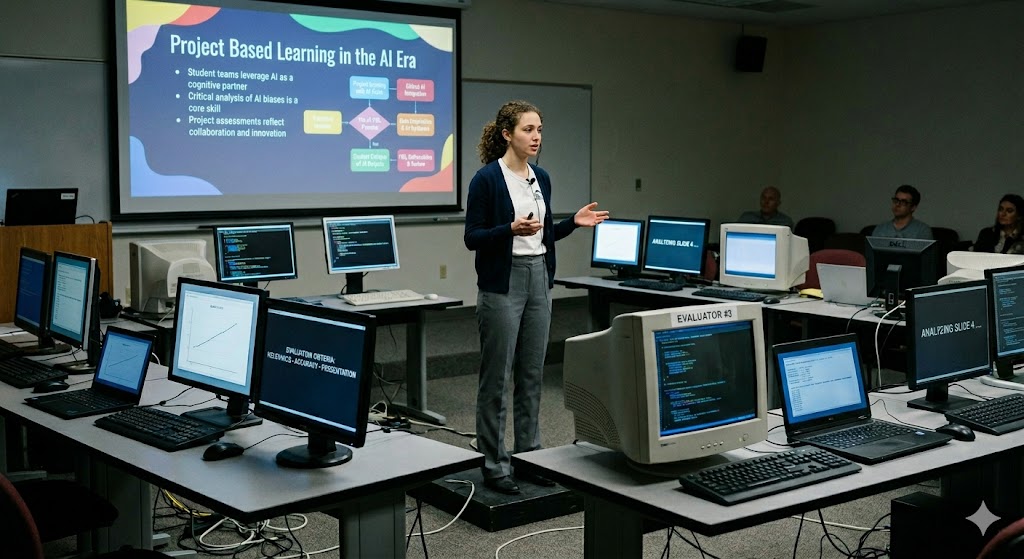
This might be wrong. If it is there are surely places AI will create tools or abilities that will make us update our mental map about what’s possible, not in exceptional circumstances but at scale. More immediately, this is just one of the ideas Michelle Croft and I will kick around on a Bellwether LinkedIn Live on June 10th, discussing what AI might mean for assessment.
Credit where it’s due. Or at least partial credit.
Overall, A250 is a hot mess. E.g., this. Or this. It’s all catnip for partisans rooting for failure and embarrassment but unfortunate for the country and people with deep love for it. It’s not the kind of bad news you should relish. 250 years of the American project is a big and world-historic milestone. This is on Trump, to be clear—he’s in charge. But we should want the celebrations to be great regardless. The way to show the country is bigger than Trump is to be bigger than Trump.
The good news, I guess, is we didn’t go straight from the Declaration to the Constitution. So as people like Danielle Allen have suggested, it should really be a decade-plus remembrance of the founding, and that will necessarily transcend administrations and create multiple opportunities for celebration and learning.
I’m the type who will take good news where I can find it. Here’s some.
Last fall, the Trump Administration put out a proposed definition for “Patriotic Education.” I was not a fan. At all. It raised a number of flags for me and seemed likely to set us up for a toggling back and forth of federal definitions about teaching history as political power changed in Washington. The final version is out today. I’m still not a fan of the whole exercise and while there are still some places I think it could be improved, the administration was responsive to feedback, and in the hands of talented educators, it’s not a cudgel.

Focusing on primary sources is an unadulterated good thing. The modern left seems not to realize how people like Frederick Douglass and Martin Luther King used the founders’ ideas and ideals to help us move toward a more perfect union. The modern right seems oblivious to what King and Douglass were talking about in the first place.
On the other hand, the definition of American Political Tradition, while also responsive to feedback, still has some shortcomings and incompleteness, in my view. It’s too static.

But if you read the analysis of comments, they (The Department of Education) did take the substantial input they received seriously. They made some changes. I suspect a broader group of players can and will participate, which is good.
There are plenty of ways all this can still go awry in Washington or in its implementation around the country (and part of the problem with this administration, of course, is that nothing is ever really settled, given the erratic “art of the deal” approach to things alongside the coercive ideology of the West Wing).
Still, for now this new definition of “patriotic education” is improved, even if the name still grates. And let’s face it, both sides, yes, would benefit from a more honest look at the founding, where it’s exceptional and how we still fall short of its lofty goals.
Want Eduwonk.com in your inbox via Substack? Sign up for free here.
View the original article and our Inspiration here