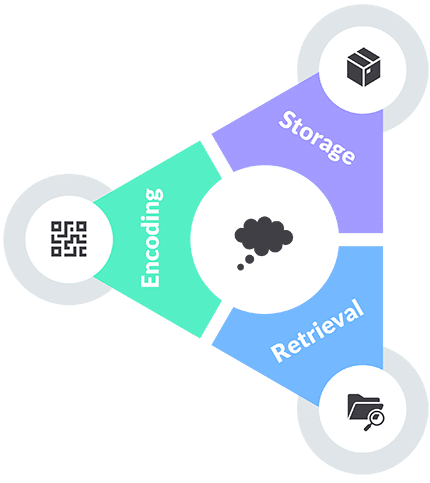
Have your students ever come into your classroom, insisting they studied and prepared for an upcoming test, yet they don’t perform nearly as well as you’d expect? While there are several reasons this could occur, one is that your students were not effectively retaining concepts to recall and apply them on an assessment. In this article, you will first learn about the three core processes of memory: encoding, storage, and retrieval, and discover briefly how those processes work together to help support learning and memory. Then, you will be introduced to one of many theories on memory, the Levels of Processing Theory, which describes how the level of processing concepts and ideas can dictate how strong your memory is.
The Three Main Stages of Memory Are Encoding, Storage, and Retrieval
Encoding is the process of taking in new information. Storage is the process of how your brain organizes and maintains information. And finally, retrieval is the act of being able to recall a specific piece of information from one’s long-term memory. These three processes work together to strengthen memory. When a student learns strong strategies for encoding new information they encounter, they store the knowledge in their memory using various strategies and techniques and then recall the information when it is needed. At each process of memorization, there are strategies students can use to strengthen their content knowledge and improve their memory. Many memory theories support strategies for improving memory, and this article will focus on the level of processing theory.
The Levels of Processing Theory
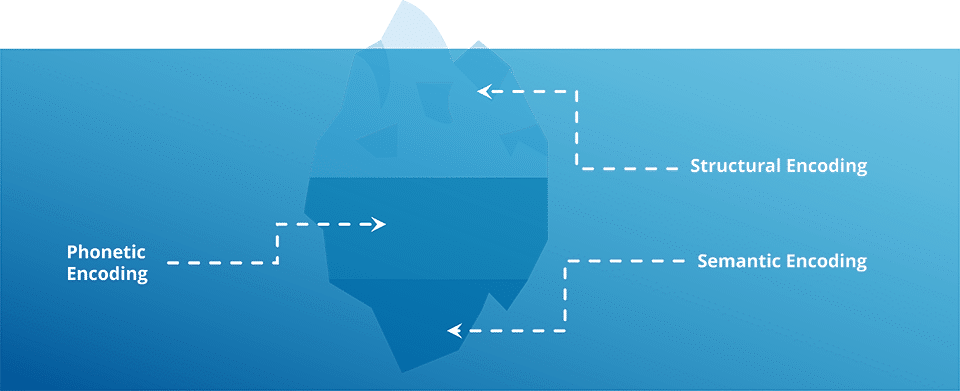
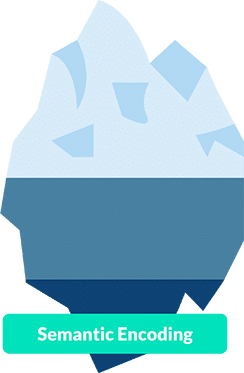
The Levels of Processing Theory, developed in 1972 by Fergus Craik and Robert Lockhart, claims that when we encode information at a meaningful level, we are more likely to recall it. In other words, the deeper the level of processing, the more likely we are to be able to recall the information later. [https://www.simplypsychology.org/levelsofprocessing.html] Researchers have defined three core levels of processing: structural encoding, phonetic encoding, and semantic encoding.
Processing Level 1: Structural Encoding
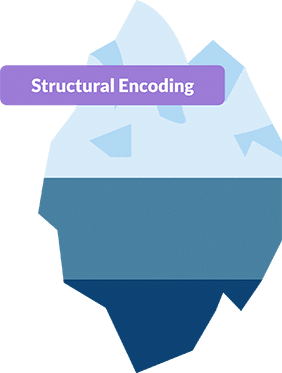
The shallowest form of processing is called structural encoding, where information is encoded based on its appearance (or structure). For example, a high school student may cram for a history exam by reading the same textbook chapter about the Holocaust over and over, hoping that by seeing the text repeatedly, it will be embedded in his/her brain and easily recalled later. While the student might remember the information in the short-term, research shows that simple review (especially of a visual image or text) is not enough for long-term memory storage.
Another example of this might be a kindergarten student learning to identify letters of the alphabet from a poster in the classroom. With each letter in the same standard block font, they may learn that “B” represents the letter B, but not be able to identify B, B or B as the same letter. Rather than internalizing the letter B, they are simply associating one specific visual with the letter B. They have only encoded the knowledge structurally, based on its appearance.
Processing Level 2: Phonemic Encoding
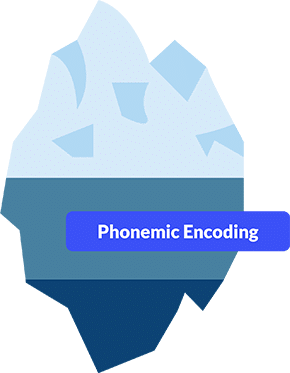
Phonemic encoding is the next level of processing, and it is deeper than structural encoding, therefore leading to an increased level of recall. While structural encoding is based on appearance, phonemic encoding is based on sound. Thinking back to the previous example of the high school student cramming for the history exam, they would likely be more successful if they read the text aloud or listened to an audio recording of it, rather than just silently reading it multiple times.
A second example of this level is when a young child “reads” a book aloud to their caregiver. While they may be able to recite the story word-for-word, they are doing this based on the sound memory of repeated readings; they may not have semantic knowledge of each individual word.
Processing Level 3: Semantic Encoding
The deepest level of processing, and that which is most likely to lead to later recall, is semantic encoding. Semantic encoding is taking in new knowledge and relating it to prior knowledge for a deeper understanding. When the same high school student studying the Holocaust thinks about the connections between his textbook chapter and his visit to the Holocaust Museum, as well as the historical fiction novel “Prisoner B-3087” he read in English class, he begins to gain a clearer, deeper understanding of the content. This process moves the information from his short-term memory and helps to embed it in his long-term memory.
Another example of semantic encoding occurs when a student learns about westward expansion in history. When they recall from a previous geography lesson the mountain ranges and deserts the settlers must have encountered, they are able to better grasp the struggles they faced as they traveled west. Making the connections between these two different lessons further cements the knowledge in their memory.
Moving students towards semantic encoding can be a simple yet effective way to encourage deeper processing.
The strategies below are likely strategies you are already using in your classroom, but now you can understand at a deeper level why these strategies are effective, based on your new understanding of the Levels of Processing Theory.
Strategy 1: Write a Summary
One way your students can generate information is through the act of summarizing information. Whether they have just read a textbook chapter or a chapter in a novel, learned a new math skill, or listened to a guest speaker or class lecture, you can have your students immediately process what they learned through any of the summary activities listed below.
Write a one-paragraph summary (can provide sentence starters or a paragraph frame for English Language Learners or students who need more support)
Turn in an exit ticket at the end, summarizing what you learned
Write a list of steps explaining how to solve a particular math problem
Create a quiz / write 5 test questions with an answer key
Keep an ongoing “Learning Log” in their notebook where they add what they have learned each day
Create a set of flashcards with key terms on one side and your own definition on the other
Strategy 2: Explain to a Partner
Another impactful strategy that is similar to summarizing, but involves student collaboration, is Explaining to a Partner. This can take on many forms, as you will see listed below, but ultimately, it involves teaching new content to someone else. We are always able to have better recall when we have TAUGHT the information, as opposed to just passively taking it in. This is just another way to engage in the generation effect!
Give One, Get One – give students 3 minutes to write down every new concept they remember, then have them pair up to share their ideas. As they give one idea to a classmate, they get one new idea from that classmate’s writing.
Dear Student letter – have each student write a letter to their classmates about what they have learned.
Turn and Talk – throughout a lesson or lecture, frequently have students turn to a partner to share what they have learned or respond to a question you pose.
A third strategy for generating information to encourage more efficient encoding is that of a Concept Map. A concept map is any type of visual aid or graphic organizer that encourages students to put their knowledge down on paper. Below are some ideas for you to consider implementing.
Draw a concept map representing what you learned and how the ideas are interconnected
Create a Venn Diagram comparing new knowledge with a previously taught concept
Sketch or write the main events of a story on a timeline or storyboard
Frayer Model for vocabulary terms: Word in the center of a page, then the four corners give a definition, defining characteristics, an example, and a non-example
Strategy 4: Hands-On Activity
Consider this classroom activity and reflect on how it supports the third level of processing, semantic encoding, by implementing this fourth strategy: a hands-on activity. In Mrs. Palencia’s 8th-grade science class, her students just completed a lab experiment with simple battery circuits. Based on that experiment, she asks them to work in pairs to generate definitions for the key terms closed circuit, open circuit, and short circuit, based on what they discovered in their experiments. Following a hands-on experiment, students worked with a partner to discuss their results and to generate their own definitions of the key terms related to circuitry. Rather than just watching a video, or reading a textbook chapter, they engaged in activities that built meaning of the three concrete terms she needed them to learn. By having students generate this knowledge, they will be more likely to understand it, process it, and recall it later.
Craik, Fergus IM, and Robert S. Lockhart. “Levels of processing: A framework for memory research.” Journal of verbal learning and verbal behavior 11.6 (1972): 671-684.
Rose, Nathan S., and Fergus IM Craik. “A processing approach to the working memory/long-term memory distinction: evidence from the levels-of-processing span task.” Journal of Experimental Psychology: Learning, Memory, and Cognition 38.4 (2012): 1019.
Loaiza VM, McCabe DP, Youngblood JL, Rose NS, Myerson J. The influence of levels of processing on recall from working memory and delayed recall tasks. J Exp Psychol Learn Mem Cogn. 2011 Sep;37(5):1258-63.
View the original article and our Inspiration here